
Chapter 1 of 5
Goloka Vṛndāvana — Krishna's innermost abode
Krishna's innermost abode, a lotus of intimate relationships
Krishna's innermost abode
Goloka
In one minute
- What
- Kṛṣṇa's own eternal home, a thousand-petalled lotus of intimate relationships.
- Mood
- Mādhurya — intimate, romantic love.
- Chart position
- The highest point of the chart, above Vaikuṇṭha.
- Key contrast
- Vaikuṇṭha emphasizes majesty; Goloka emphasizes intimacy.
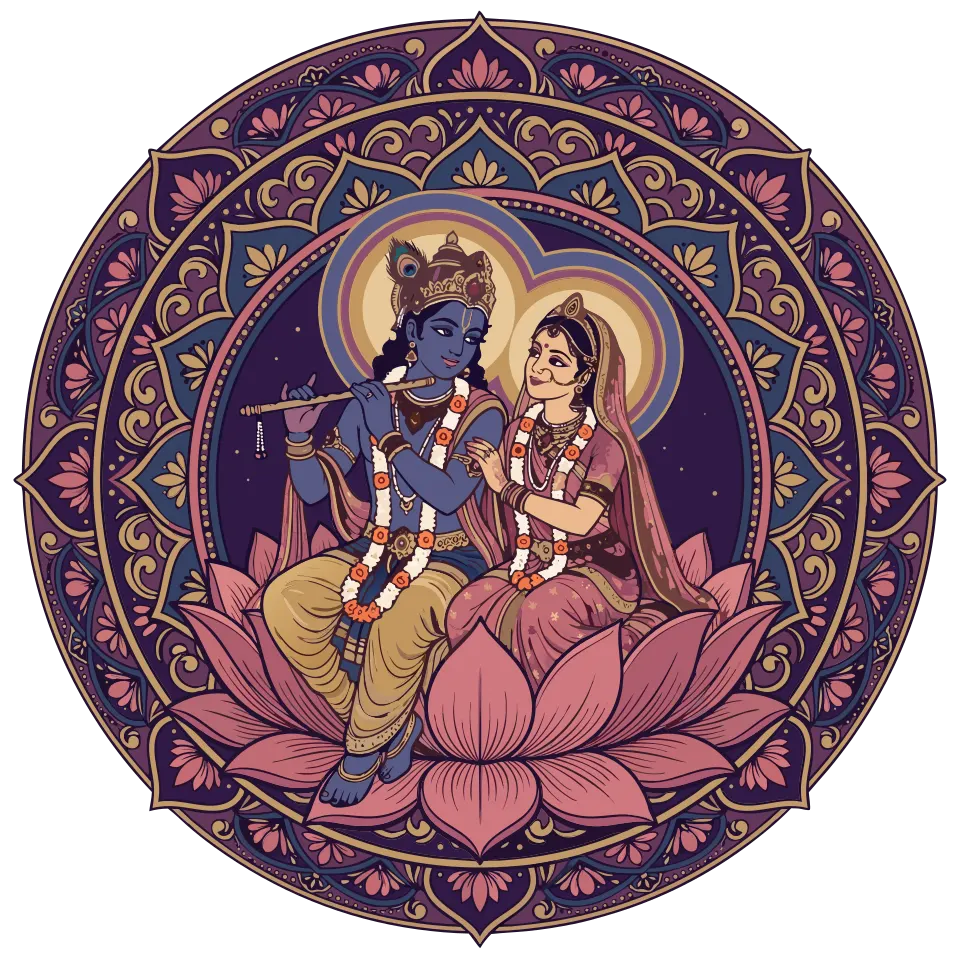
You've arrived at Goloka, Kṛṣṇa's own eternal home: a many-petalled lotus with Kṛṣṇa and Rādhā at its center, and His closest companions gathered around them.
Source: Brahma-saṁhitā 5.2–5, 5.29
Visual legend
- Center medallion
- Rādhā and Kṛṣṇa together at the lotus's central whorl, the .
- North, east, south, west markers
- The four divisions surrounding the lotus.
- Ring of eight dots
- The eight principal , Rādhā's closest companions.
- Corner medallion
- Ayodhyā, Śrī Rāma's own realm, marked beside the descent.
Not one form among several
The chart's whole vertical axis, every realm below this one, ultimately answers to a single claim about who sits at this exact point. Not one form of God among several, the tradition says — Svayaṁ Bhagavān, the original Supreme Person, the very source the other forms expand from.
Person, not portrait
So the chart's center isn't a portrait hung in a frame. It's the innermost point of a world built entirely out of relationship, and everything else on this chart is, in some sense, describing what surrounds Him.
Central whorl of the thousand-petalled Goloka lotus
Every other realm on this chart — Vaikuṇṭha's majesty, Maheśa-'s threshold, the material universes — is described here as radiating outward from this one point. Fixing Kṛṣṇa's position at the center first is what makes every other realm's position make sense.
Source: Brahma-saṁhitā 5.1–5; Gauḍīya theological explanation · Direct scriptural supportThe rest of the chart gets very detailed, but its basic point is simple: everything is arranged around a personal relationship with Kṛṣṇa.
Kṛṣṇa's innermost abode
Each of those thousand petals belongs to Kṛṣṇa's companions — the flower isn't decoration around Him, it's made of the people closest to Him. The eight principal get their own separate treatment: a ring of dots immediately around the center, not eight specific petals among the thousand. None of this is a botanical claim; the lotus is the chart's way of drawing infinity as something that still has a center and a shape.
Three divisions of one intimacy
The same realm is also read three other ways at once. Gokula, Mathurā, and Dvārakā name three moods of the same intimacy, not three stops on a road — nothing here measures distance in miles. Step outside the lotus and the familiar landscape opens up: Govardhana Hill, the Yamunā's banks, Rādhā and the and moving through what looks like an ordinary countryside. Then carries that same warmth outward again, into Caitanya Mahāprabhu's era of sharing it freely with anyone willing to receive it.
What the abode is made of
The verse the chart takes its bearings from — 5.29 — describes Goloka in almost physical terms: dwellings built of cintāmaṇi, the wish-granting gem; groves of -vṛkṣa, trees that yield whatever is asked of them; herds of surabhī cows; countless lakṣmīs attending Govinda. The imagery isn't there for opulence. Where a gem grants any wish and a tree bears any fruit, nothing is scarce and nothing has to be secured or competed for — which is the tradition's way of saying the love in this realm carries no calculation, because there is nothing left to calculate about.
Upper and central spiritual section of the chart
This is the one image the whole site keeps returning to — every realm's position, every chapter's next stop, gets its bearings from this same lotus.
Source: Brahma-saṁhitā 5.2–5, 5.29 · Direct scriptural supportThe rest of this realmThe other places on this chart, Sanskrit terms, and source links
Goloka
goh-LOH-kuh
Kṛṣṇa's own eternal abode, the intimate summit of the spiritual sky.
Mādhurya
MAH-dhoor-yuh
Sweetness; the mood of intimate, romantic love with Kṛṣṇa.
Hlādinī-śakti
lah-dee-NEE SHUCK-tee
The Lord's internal potency of divine love and bliss, embodied by Rādhā.
In this realm
 The Eight Sakhīs
Naming all eight rather than labelling them 'the eight sakhīs' and moving on is deliberate — the ring closest to Rādhā and Kṛṣṇa is the chart's image of intimacy, and intimacy here is specific: these names, these temperaments.
Read the full entryLalitāLeader of the eight — devotion fierce enough to speak plainly, even to Kṛṣṇa himself.ViśākhāRādhā's closest confidante among the eight sakhīs.CitrāKnown among the eight sakhīs for her artistry.CampakalatikāNamed for a fragrant flowering vine, among the eight principal sakhīs.TuṅgavidyāKnown among the eight sakhīs for being learned and articulate.IndulekhāHer name means "crescent of the moon," one of the eight principal sakhīs.RaṅgadevīKnown among the eight sakhīs as the one who brings festivity.SudevīKnown among the eight sakhīs for quiet steadiness. Three Divisions of Kṛṣṇaloka
Naming the three as moods rather than places is what keeps the chart from being read as a travel map — Gokula, Mathurā, and Dvārakā are three ways Kṛṣṇa is met, not three points anyone moves between.
Read the full entry- Concentric Dhāmas around Śvetadvīpa
It shows the tradition distinguishes between "mood" (the Gokula/Mathurā/Dvārakā of feeling) and "place" (this concentric geography) — two different kinds of map layered on the same territory.
Read the full entry - Navadvīpa
Putting Navadvīpa on the same lotus's outer petals says Caitanya's openness isn't a separate revelation from Goloka's intimacy — it is that intimacy turned outward, made shareable through the holy name.
Read the full entry  Northern Śvetadvīpa Division
Part of Śvetadvīpa's fourfold symbolic structure — Atharva Veda, Mokṣa — showing the chart layers several systems of meaning (direction, Veda, life-goal) onto the same quadrant.
Read the full entry- Eastern Śvetadvīpa Division
Part of Śvetadvīpa's fourfold symbolic structure — Ṛg Veda, Dharma — showing the chart layers several systems of meaning (direction, Veda, life-goal) onto the same quadrant.
Read the full entry - Southern Śvetadvīpa Division
Part of Śvetadvīpa's fourfold symbolic structure — Yajur Veda, Artha — showing the chart layers several systems of meaning (direction, Veda, life-goal) onto the same quadrant.
Read the full entry - Western Śvetadvīpa Division
Part of Śvetadvīpa's fourfold symbolic structure — Sāma Veda, Kāma — showing the chart layers several systems of meaning (direction, Veda, life-goal) onto the same quadrant.
Read the full entry  Baladeva / Balarāma
Baladeva is why the chart can call Goloka a living reality rather than a landscape: the mood of service is what holds the realm ready for Kṛṣṇa's pastimes, the way Ananta Śeṣa is said to bear the worlds.
Read the full entry- Śrīmatī Rādhārāṇī
Rādhā is why the chart's center reads as love and not rank — she is the tradition's image of devotion so complete it becomes the standard every other kind of love is measured against.
Read the full entry - Catur-vyūha
The same four names recur in Śvetadvīpa and inside Vaikuṇṭha because the chart is tracing one continuous principle, not four unrelated deities — creation, maintenance, and dissolution are functions of a single source, not separate powers competing for the role.
Read the full entry  Six-cornered Yogapīṭha
Drawing the center as a six-cornered figure rather than a point is the chart's way of saying the middle isn't just where things converge — it is a constructed sacred space, a yantra, with its own inside.
Read the full entry- Śvetadvīpa
The four sections are correspondences, not districts — reading them as places (a northern country, a southern one) misses that the chart is using one square to hold divine forms, Vedas, and human aims at once.
Read the full entry  Śvetadvīpa Symbolic Features
The chart could have left Śvetadvīpa an unmarked square. Adding tridents, treasures, protectors, and colors says the tradition wants this realm read as complete and guarded, not as an empty diagram waiting to be filled in.
Read the full entry- Vraja / Gokula Landscape
Naming the cows, the hill, the river and the groves is the chart's way of refusing to treat them as backdrop — each stands for a devotional mood (friendship, parental love, romantic love) the tradition wants held as fully real.
Read the full entry
Key elements
The Goloka lotus
A thousand-petalled lotus symbolizing the eternal realm, not a literal flower.
Śvetadvīpa
The region around the lotus, divided into four sections linked to the Catur-vyūha.
Eight sakhīs
Rādhā's closest companions, arranged around the center.
Three līlā divisions
Gokula, Mathurā, and Dvārakā, told apart by mood.
Concentric dhāmas
The same three names shown again as a separate concentric geography layer.
Ayodhyā
Held apart from the descent, with its own devotional mood entirely.
Common confusions
The mood divisions and the concentric geography share the same three names, so they must be the same map.
They're two separate layers over the same realm: one grouped by mood (Gokula, Mathurā, Dvārakā), the other by concentric chart geography (Mathurā, Jagannātha Purī, Dvārakā). Toggle between them above the map.
Ayodhyā must be a stop somewhere along the path from Goloka to Vaikuṇṭha.
Ayodhyā isn't a rung on that ladder — it's marked beside the descent, not on it, complete in its own right.
The north, east, south, and west markers are ordinary compass directions.
They mark 's four symbolic divisions, linked to the and the four , not geography.
Frequently asked questions
- What is Goloka?
- Goloka is Kṛṣṇa's own eternal home in cosmology — a thousand-petalled lotus with Kṛṣṇa and Rādhā at its center, surrounded by their closest companions. It sits at the highest point of the Goloka Chart, above Vaikuṇṭha.
- What is the difference between Goloka and Vaikuṇṭha?
- Goloka emphasizes , intimate personal love for Kṛṣṇa; Vaikuṇṭha emphasizes , reverent awe toward Nārāyaṇa's majesty. Goloka sits one realm above Vaikuṇṭha on the chart.
- Who are the eight sakhīs (aṣṭa-sakhī) of Goloka?
- The eight principal are Rādhā's closest companions, shown as a ring of eight around the central medallion where Rādhā and Kṛṣṇa stand together at the lotus's .
- Are Goloka's mood divisions and its concentric geography the same map?
- No — they're two separate layers over the same realm: one groups zones by devotional mood (Gokula, Mathurā, Dvārakā), the other by concentric chart geography (Mathurā, Jagannātha Purī, Dvārakā), toggled separately above the map.
Pause and reflectTap to open a short reflection prompt
Where in your own picture of spiritual life is there room for beauty, variety, and relationship, and where is it still just emptiness?
Below Goloka's intimacy opens the spiritual sky: countless Vaikuṇṭha realms, where the same Lord is known in majesty.
Descend to Vaikuṇṭha's majesty