
Chapter 5 of 5
Devī-dhāma — the material universe
The material universe, fourteen layered worlds, and yours among them
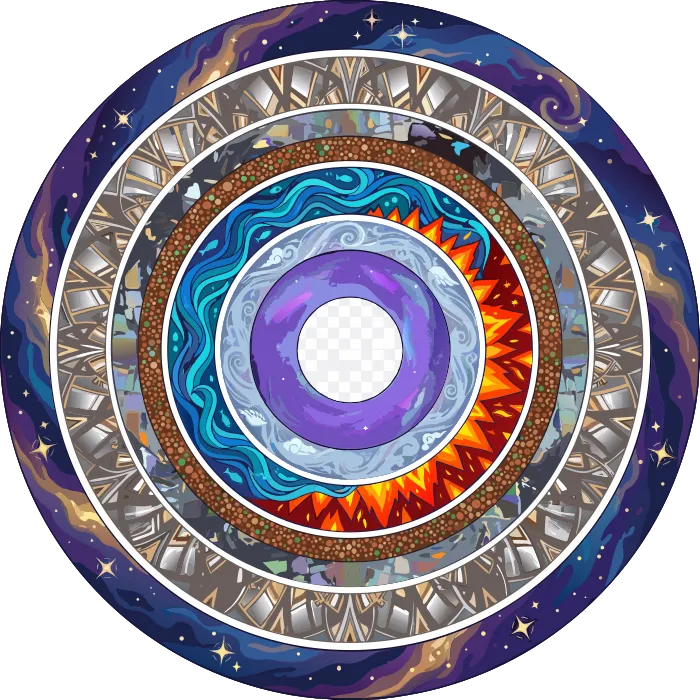
The material universe
Devī-dhāma
In one minute
- What
- The material universe: fourteen planetary systems governed by Māyā under the Lord's authority.
- Mood
- Conditioned existence — karma, time, birth and death, not a devotional mood of its own.
- Chart position
- The lowest major region of the chart, below the Threshold.
- Key contrast
- Unlike the realms above it, this world is temporary and conditioned, though the tradition doesn't call it a punishment.
The descent ends here, in Devī-: the material universe, fourteen planetary systems resting on 's seven islands and seven oceans, governed by Māyā under the Lord's authority.
Source: Brahma-saṁhitā 5.43–44; Devī Māhātmya; Śrīmad-Bhāgavatam; chart explanation
Visual legend
- Segmented wheel
- The fourteen planetary systems, seven ascending and seven descending.
- Ringed border
- Sun, moon, and star motifs marking the material universe's boundary.
The material world
This is where the descent ends up — and where the reader almost certainly already lives. Devī- is the material world: the chart's name for everywhere karma unfolds, time moves in one direction, and birth and death keep repeating inside universe after universe. It's governed by the Lord's own external potency, personified in the chart as Durgā — and the tradition is specific about her standing: she acts here under Govinda's authority, carrying out His arrangement, not running some rival operation of her own.
Durgā's own image
Commentary built on this verse gives her ten arms, each bearing a different weapon gathered from the gods, and a lion carrying rather than restraining her fierce readiness. Beneath her feet is Mahiṣāsura, the shape-shifting buffalo-demon of the Devī Māhātmya — not proof that her power is punitive, but a reminder that the confusion and stubborn ignorance he represents can be met and settled by an integrated, higher power. None of this reduces her: Śākta traditions worship Durgā herself as supreme reality, and this chart's placement of her as Govinda's potency is one lineage's reading, not the last word on who she is.
Fourteen realms of experience
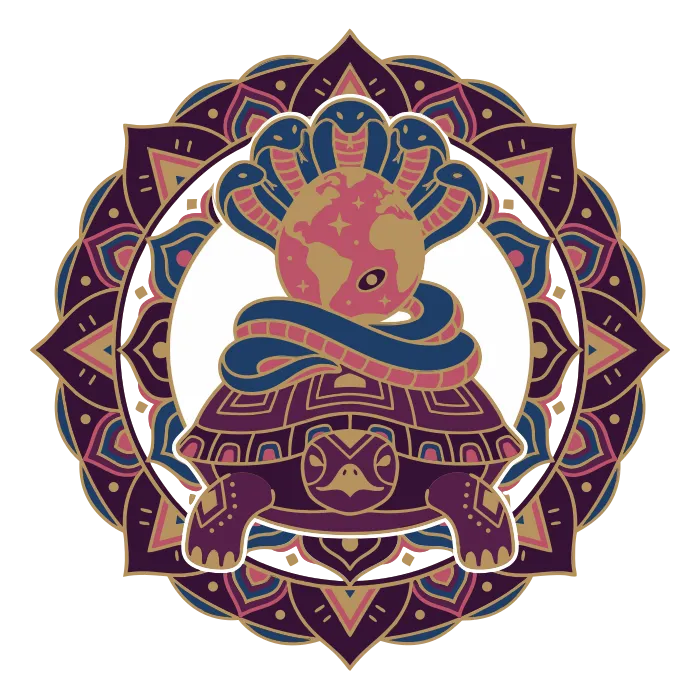
Zoom into a single universe and it unfolds into fourteen planetary systems, stacked seven above and seven below, resting on the older cosmography of 's seven islands ringed by seven oceans. Somewhere inside that is , and inside that, — held up, in this tradition, as the one place in the whole stack best suited to spiritual effort. Zoom out again and the entire arrangement turns out to be resting on something, not floating free: the , material nature's total principle, pictured as a universe held up by Kūrma and Ananta Śeṣa rather than sustaining itself.
Lowest major region of the chart
Every earlier chapter describes somewhere else. This one describes where the reader is actually reading from — which is why the site's own return path starts here and works backward toward Kṛṣṇa, not the other way around.
Source: Brahma-saṁhitā 5.43–44; Devī Māhātmya; Śrīmad-Bhāgavatam; chart explanation · Direct scriptural supportJambūdvīpaThe central island, containing Bhārata-varṣa — the only place in this cosmology specifically noted as ideal for spiritual effort, not just enjoyment.
Central island, contains Bhārata-varṣa
Plakṣadvīpa
Named for the sacred fig tree at its center — abundance spreading outward from a single rooted source.
Śālmali-dvīpa
Named for the silk-cotton tree — strength and shelter, its canopy vast enough to shade what surrounds it.
Kuśadvīpa
Named for sacred kuśa grass, used in ritual across the tradition — the ordinary material that ritual makes significant.
Krauñcadvīpa
Named for a mountain associated with Kārttikeya — protection standing at the edge of the known world.
Śākadvīpa
Named for the śāka tree — often associated with sun-worship and disciplined order.
Puṣkaradvīpa
The outermost island, named for the lotus — the map of the material world fittingly ends on the same symbol its spiritual counterpart begins with.
The rest of this realmThe other places on this chart, Sanskrit terms, and source links
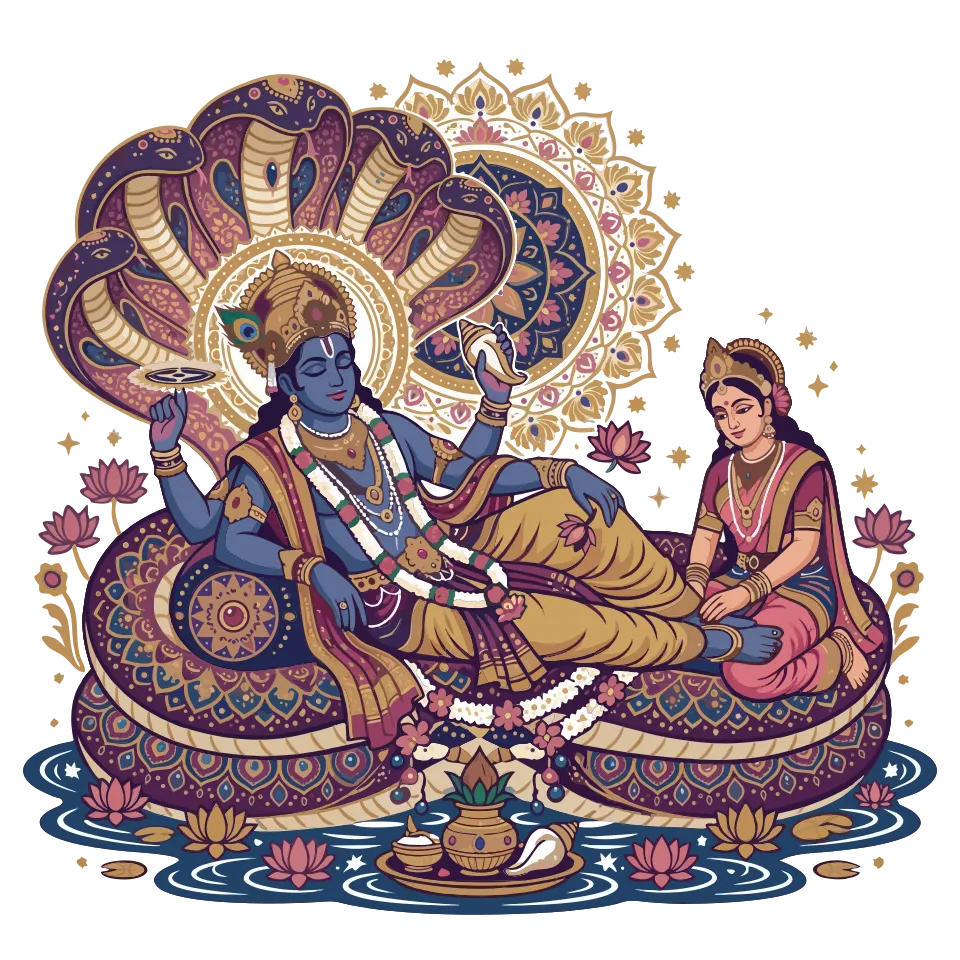
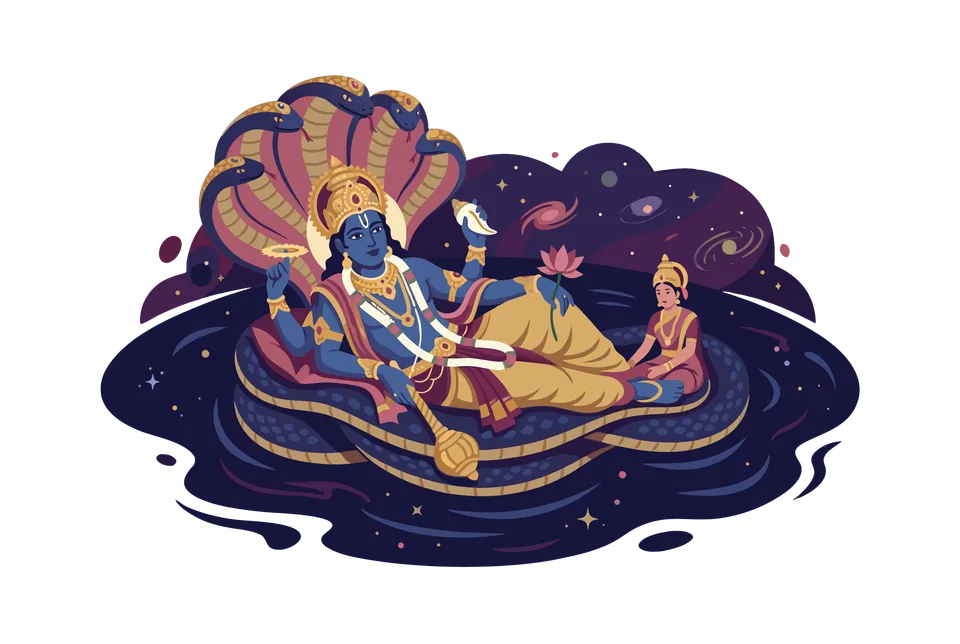
The tradition doesn't describe this world as a punishment to escape. It's where the work of a spiritual life actually happens.
Devī-dhāma
DAY-vee DAH-muh
The material world, a temporary and conditioned part of the Lord's larger reality.
Māyā
MAH-yah
The Lord's external energy, governing the material world under His authority.
Bhū-maṇḍala
BOO-mun-duh-luh
The traditional cosmography of seven islands and seven oceans.
The full descent
Everything above Devī-dhāma, top to bottom — tap a layer to read more, or to look up.
In this realm
 Mahat-tattva, Pradhāna, and Prakṛti
The chart gives matter an origin and an internal structure so it can't be read as a second reality standing outside the divine order — even the causal principles sit inside the diagram, below the boundary, not beyond it.
Read the full entry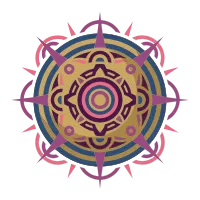 Fourteen Planetary Systems
It refuses the flat idea that "the material world" is one undifferentiated place — even matter has its own internal hierarchy, without any of it being outside the system entirely.
Read the full entryŪrdhva-loka — the seven higher worlds
BhūrlokaEarth is here
Earth and mortal beings
Earth itself — the planetary system human life occupies, where karma is made, not just experienced.
Adho-loka — the seven lower worlds
 Kūrma, Ananta Śeṣa, and Dik-gajas
In the chart's traditional support imagery, it shows the material universe isn't self-supporting — even its physical stability rests on a form of the Lord holding it up.
Read the full entry Jīva, Bondage, and Bhakti
It's the reason the rest of the chart matters at all — a map of realms only means something if there's a traveler who can actually move through them, and bhakti is the tradition's account of how that movement happens.
Read the full entry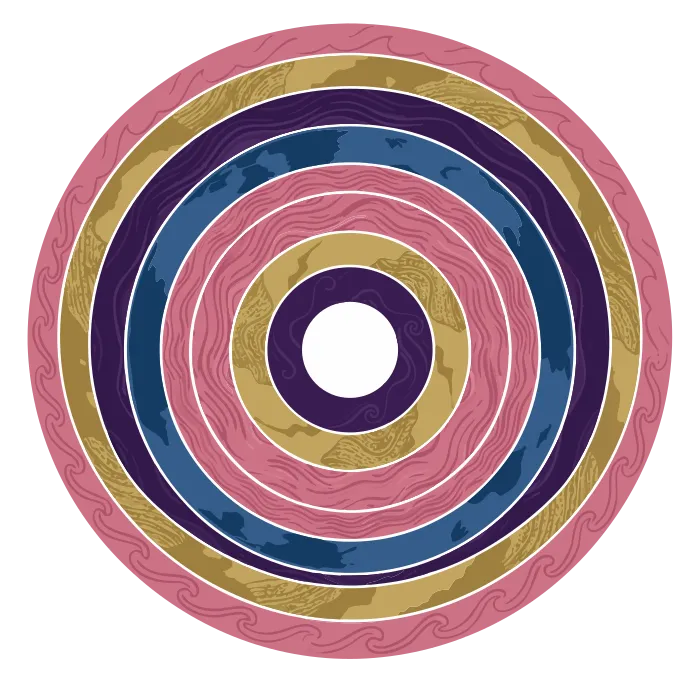 Universal Coverings
Each covering is traditionally ten times thicker than the one inside it — scaled from the inner universe's own roughly 4-billion-mile span, that puts the earth covering alone at about 40 billion miles thick, water beneath it ten times that again, and so on outward. The material universe this chart maps is a single grain wrapped in layers vaster than itself, inside a sky with room for uncountable other universes just like it.
Read the full entryEarth
The outermost, coarsest covering — solidity itself, the last and thickest layer before the universe's contents begin.
Water
Beneath earth in the traditional ordering, each covering ten times thicker than the one it surrounds — fluidity giving way to solidity.
Fire
The covering of heat and light — subtler than the water and earth beneath it, coarser than what lies above.
Air
Movement and breath as a covering layer — subtler still, closer to the universe's unmanifest origin.
Ether
Space itself as a covering — the subtlest of the five gross elements, the medium the others arise within.
False ego
Ahaṅkāra — the point where undifferentiated matter first takes on the sense of "I," the seed the gross elements unfold from.
Mahat-tattva
The total material energy in its first manifest state, before it differentiates into ego, elements, or anything nameable.
Pradhāna
Unmanifest primordial matter itself — prakṛti before it has begun to unfold into any of the layers it will become.
- Bhū-maṇḍala
It's the chart's only zone that places ordinary human life on the map at all — everywhere else here is a realm beyond material experience, but Bhārata-varṣa inside Bhū-maṇḍala is where the tradition says the reader of this chart is actually standing.
Read the full entry
Key elements
Fourteen planetary systems
Seven ascending and seven descending, resting one on another.
Bhū-maṇḍala
Seven islands and seven oceans, with Jambūdvīpa at the center.
Mahat-tattva
Material nature's total principle underlying the universe.
Māyā
The Lord's external energy, pictured as Durgā, acting under Govinda's authority.
Common confusions
The fourteen planetary systems and are two competing maps of the same thing.
's seven islands and oceans are the older cosmography the fourteen-system layout rests on, not a rival scheme.
Māyā is an independent power opposing the Lord.
The chart is explicit that Māyā acts under Govinda's own authority, not as a rival.
Frequently asked questions
- What are the fourteen planetary systems?
- The fourteen planetary systems are seven ascending and seven descending systems resting one on another, forming the material universe — Devī- — in this chart's cosmology.
- What is Bhū-maṇḍala?
- is seven islands and seven oceans with at the center — the older cosmography that the fourteen-planetary-system layout rests on, not a rival scheme.
- Is Māyā an independent power opposing the Lord?
- No — the chart is explicit that Māyā, pictured as Durgā, acts under Govinda's own authority governing the material world, not as a rival force.
- What is Devī-dhāma's place in the Goloka Chart?
- Devī- is the chart's lowest major region — the material universe, temporary and conditioned by karma, time, birth, and death — reached below the Threshold.
Pause and reflectTap to open a short reflection prompt
How much of what you take to be all of reality might really be a temporary, conditioned slice of something larger?
Beneath even the fourteen worlds lies one more step, not a place but a return: the way the finds its way home.
The way home begins here