
From the reflection archive · 19 August 2026
A quiet reminder for your day
Universal Coverings
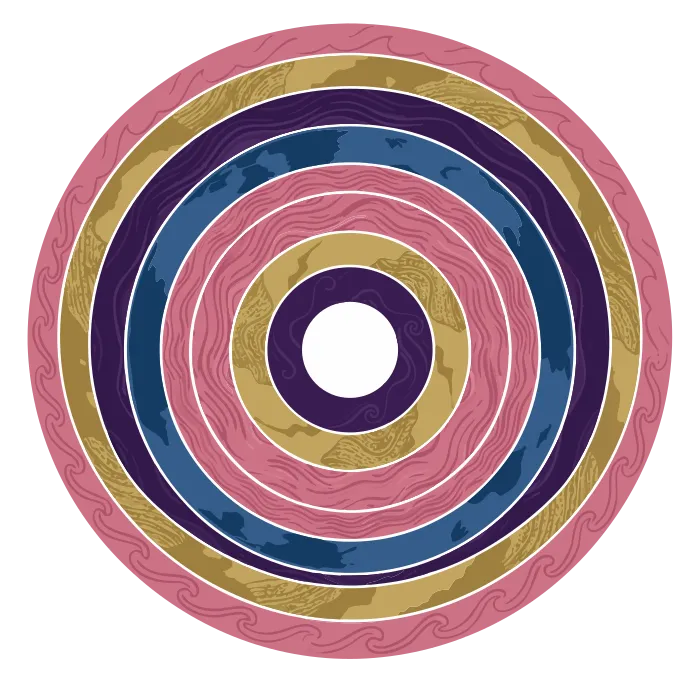
However large a single life or world feels from the inside, the tradition's own cosmology treats it as one covered seed among countless others — not to shrink it, but to place it.
— Universal Coverings
Reflect on this
What changes if you hold your life as large from the inside and small from outside at once?
The material universe is shown as a , or cosmic egg, surrounded by successive coverings. The chart lists earth, water, fire, air, ether, false ego, , and . These belong to Purāṇic cosmography and should not be treated as a modern scientific model of planetary space.
Wrapped entirely around and the fourteen planetary systems — the outermost boundary of one material universe, before the spiritual sky beyond it.
Each covering is traditionally ten times thicker than the one inside it — scaled from the inner universe's own roughly 4-billion-mile span, that puts the earth covering alone at about 40 billion miles thick, water beneath it ten times that again, and so on outward. The material universe this chart maps is a single grain wrapped in layers vaster than itself, inside a sky with room for uncountable other universes just like it.
Source: Śrīmad-Bhāgavatam 3.26.52; chart explanation · Direct scriptural supportEarth
The outermost, coarsest covering — solidity itself, the last and thickest layer before the universe's contents begin.
Water
Beneath earth in the traditional ordering, each covering ten times thicker than the one it surrounds — fluidity giving way to solidity.
Fire
The covering of heat and light — subtler than the water and earth beneath it, coarser than what lies above.
Air
Movement and breath as a covering layer — subtler still, closer to the universe's unmanifest origin.
Ether
Space itself as a covering — the subtlest of the five gross elements, the medium the others arise within.
False ego
Ahaṅkāra — the point where undifferentiated matter first takes on the sense of "I," the seed the gross elements unfold from.
Mahat-tattva
The total material energy in its first manifest state, before it differentiates into ego, elements, or anything nameable.
Pradhāna
Unmanifest primordial matter itself — prakṛti before it has begun to unfold into any of the layers it will become.